


Company Credit Report Explained: How to Evaluate Financial Reliability

A company credit report helps you assess whether a business can meet its obligations before approving terms or granting trade credit. By compiling verified credit information into a single credit report, it ensures your credit assessment is based on evidence, not impressions.
Definition: What a Company Credit Report Is
A company credit report is a structured credit check output that summarizes company information (the legal entity you will be contracting with) and indicators supporting a risk assessment (including warning signals that could increase credit risk).
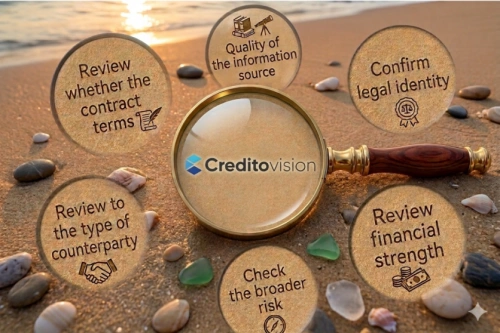
Step 1: Verify the Legal Entity First
Financial reliability only matters if you’re reviewing the correct company.
What to confirm:
- Legal name and registration identifiers
- Current status (active/inactive) and legal form
- Address and operating footprint
- Ownership / management structure (and recent changes)
Why it matters: A mismatch between the contracting entity and the “brand name” used in emails, proposals, or invoices is a common source of disputes and delayed payments.
Step 2: Separate “One-Off Delays” from Payment Patterns
Reliability is usually about patterns, not anecdotes. One late invoice can happen to anyone; repeated delays are different.
What to look for:
- Repeated late-payment signals vs. isolated incidents
- Sudden requests for longer terms or a higher limit
- Frequent changes in directors, address, or structure (often linked to instability)
Practical tip: When multiple weak signals appear together, treat it as higher credit risk even if one metric looks acceptable.
Step 3: Treat Legal and Negative Events as Constraints
Legal issues can change risk quickly and may affect enforceability.
Pay attention to:
- Insolvency steps or restructuring signals
- Ongoing disputes with creditors
- Enforcement actions (where available)
How to use this: If active disputes exist, don’t only “reduce the limit.” Tighten the control: shorter terms, staged delivery, or partial upfront payment.
Step 4: Use Financials Carefully (When Available)
- Some reports include financial statements or ratios; others provide limited financial detail depending on the country and disclosure norms. Company financial report sections (balance sheet, income statement, cash-flow when available) help you see capacity.
How to read financial reliability:
- Liquidity and short-term pressure matter for paying invoices
- High leverage can reduce flexibility during market shocks
- Consistency over time is more meaningful than a single strong year
If financials are limited, don’t assume “no data = no risk.” Treat missing data as uncertainty and manage exposure accordingly.
Step 5: Watch Governance and Ownership Stability
Ownership and management changes can be normal—but sudden or frequent changes can signal instability.
What to evaluate:
- Recent shareholder or director changes
- Complexity (multiple connected entities, unclear control)
- Whether governance looks stable enough for the size of credit requested
This is where disciplined risk management helps: you’re not judging character, you’re reducing preventable surprises.
Step 6: Put Activity and Market Context Around the Risk
Even reliable companies can struggle in stressed sectors. Reliability improves when you align terms with reality.
Useful checks:
- Does the operating scale match the order size?
- Is the company dependent on one product/market?
- Are there signs of aggressive growth that may strain cash flow?
- How is trade information (trade references, market position, sector comparisons…)
Step 7: Use the Risk Score as a Decision Tool (Not a Verdict)
Many reports provide a risk score. Think of this score as a guide, not a final verdict.
• Score = Prioritization → tells you which companies need deeper review.
• Score + Evidence = Terms → combine with payment history and legal events to set limits, payment days, and safeguards.
• Score + Trend = Monitoring → watch changes over time; improving scores need less frequent checks, declining scores need closer monitoring.
In short: the risk score is useful, but only when read in context.
Mini Case: Ignoring Warning Signals Leads to Loss
A distributor receives a large order from an overseas customer. The buyer requests 45-day trade credit terms. Considering the potential revenue, the distributor quickly agrees without thorough due diligence.
What Would the Credit Report Show?
• Payment Reliability: A history of repeated late payments to other suppliers.
• Legal and Adverse Events: Ongoing creditor disputes and a pending restructuring lawsuit.
• Risk Score: Rated as high-risk, showing a downward trend over the past six months.
Result
• The buyer delays payments by more than 90 days.
• Cash flow deteriorates, and the distributor is forced to borrow short-term funds at high interest rates.
• Legal action against the buyer becomes costly and slow due to cross-border enforcement issues.
So, failing to make company solvency check as part of the decision-making process exposed the distributor to preventable losses. This incident demonstrates how ignoring risk assessment and credit check signals can turn a promising deal into a financial setback.
Practical Checklist: Evaluate Reliability in Minutes
- Confirm company information matches the contracting entity.
- Scan for negative events and recent structural changes.
- Look for repeated payment-stress signals (patterns, not one-offs).
- Use risk assessment to align limit and terms with exposure.
- Apply safeguards when uncertainty is high (shorter terms, staged delivery).
- Document the decision for consistency across your team.
If a company has a good business credit score, is it automatically reliable?
Not automatically. Use the credit score as a starting signal, then confirm the drivers: stability, disputes, payment patterns, and (if available) the company financial report trend. A “good score” plus recent negative events can still require tighter terms.
A company credit report helps you evaluate financial reliability in layers—legal identity, stability signals, and decision guidance—so you can reduce credit risk and extend trade credit more safely. The best results come from consistency: a clear credit assessment process applied the same way across partners. To see how trusted company credit reporting can support more confident decisions, visit Creditovision. https://portal.creditovision.com/